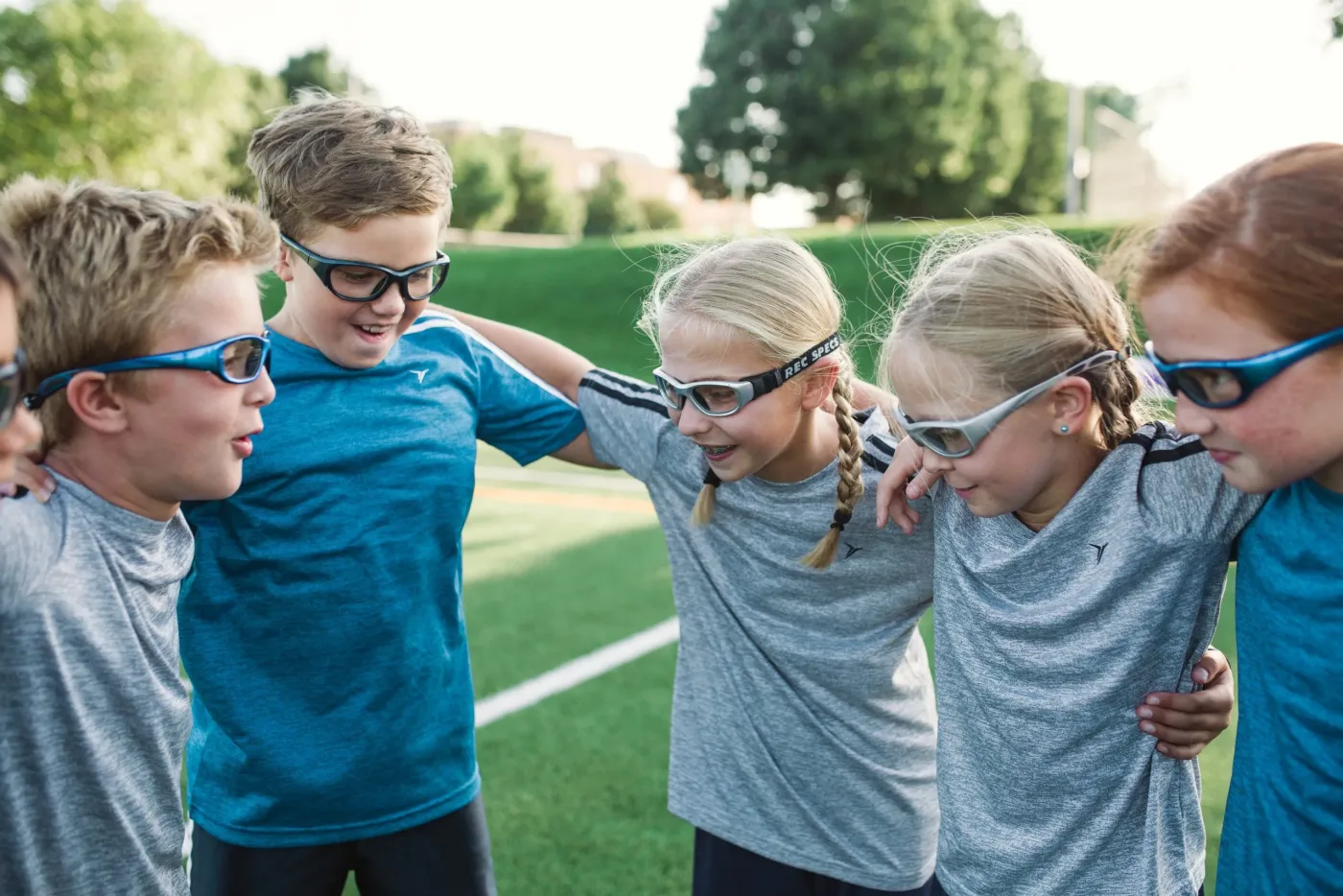
Sports are one of the most common reasons children ask for contact lenses.
- Glasses can slide down.
- They can fog.
- They can bounce during running.
- They can feel uncomfortable under helmets.
- They can fall off during play.
- They can make some children feel self-conscious.
So when a child plays soccer, basketball, baseball, dance, gymnastics, cheer, martial arts, tennis, or another activity, contact lenses can seem like the perfect answer.
Sometimes they are a great option.
But there is one important thing every parent needs to understand:
Contact lenses help your child see. They do not protect your child’s eyes.
If your child plays a sport with a risk of impact, they may still need protective sports eyewear, even if they wear contacts.
Why Contact Lenses Can Help During Sports
Contact lenses can make sports easier for many children and teens.
They move with the eye, so the child has a wider field of view than they may have with glasses. They do not slide down the nose. They do not fog as easily. They do not get bumped out of position the same way glasses can.
For some children, contacts can improve confidence and comfort during sports.
They may help with:
- Seeing the ball
- Tracking players
- Judging distance
- Moving confidently
- Seeing from the side
- Wearing helmets more comfortably
- Avoiding glasses sliding with sweat
- Participating without worrying about broken frames
- Feeling more confident around teammates
- Reducing distractions from glasses during movement
This can matter a lot for active kids.
A child who hates wearing glasses during sports may do much better with contact lenses, as long as they are ready for the responsibility.
Contacts Do Not Protect the Eyes
This is the biggest point.
Contact lenses do not protect against a ball, finger, elbow, stick, racket, fall, or collision.
They sit on the eye and correct vision.
They do not cover the eye like safety goggles.
They do not replace sports goggles.
They do not prevent eye injury.
For many sports, a child can wear protective sports eyewear over contact lenses.
That combination can work well because the contacts correct the vision and the goggles protect the eyes.
Regular Glasses Are Not Sport Goggles
Regular glasses are also not the same as protective sports eyewear.
Even if the lenses are impact resistant, the frame may not be designed for sports impact.
Regular glasses can break, bend, fall off, or get pushed into the face during an injury.
Sport protective eyewear is designed differently. It is made to protect the eyes during activity and should be matched to the sport when possible.
If your child plays a sport with eye injury risk, ask the eye doctor whether they need sport goggles, even if they wear contacts.
Which Sports Have More Eye Injury Risk?
Any sport can lead to an eye injury, but some sports carry more risk because of balls, sticks, elbows, fingers, speed, or close contact.
Sports where protective eyewear may be especially important include:
- Basketball
- Baseball
- Softball
- Soccer
- Lacrosse
- Hockey
- Racquetball
- Squash
- Tennis
- Martial arts
- Football
- Volleyball
- Field hockey
- Wrestling
- Paintball
- Mountain biking
This does not mean every child in every sport needs the same type of protection.
The right eyewear depends on the sport, position, age, prescription, risk level, and whether the child has any eye health or vision history that makes protection even more important.
Why Basketball Is a Common Problem
Basketball is a very common sport for eye injuries because fingers and elbows are close to the face.
A child wearing contacts may see clearly on the court, but a contact lens will not stop a finger poke.
A child wearing regular glasses may also be at risk because the frame can be hit or pushed into the face.
For basketball, sport protective eyewear is often worth discussing.
This is especially true if your child has a strong prescription, reduced vision in one eye, prior eye injury, or a history of eye surgery.
Why Baseball and Softball Matter
Baseball and softball involve fast-moving balls.
A ball can hit the eye directly or strike the face.
Children may need different protection depending on whether they are batting, fielding, catching, or playing another position.
Contacts can help your child see the ball clearly, but they do not protect from impact.
Ask about sport-specific protection, especially if your child has a prescription and is playing competitively.
What About Soccer?
Soccer injuries can happen from balls, elbows, collisions, and falls.
Many children do well with contacts for soccer because glasses can slide or break during play.
But eye protection may still be worth discussing, especially for children with higher risk history or more competitive play.
If your child wears regular glasses during soccer and they keep getting hit, bent, or broken, that is a sign to ask about contacts, sport eyewear, or both.
What About Dance, Gymnastics, and Cheer?
Dance, gymnastics, and cheer may not involve balls or sticks, but glasses can still be difficult.
Glasses may slide, fall off, interfere with movement, or distract the child during routines.
Contacts can be very helpful for these activities.
Protective eyewear may not be needed in the same way it is for high-impact ball sports, but the child still needs safe contact lens habits.
That means no sleeping in lenses, no water exposure, and no wearing lenses through pain, redness, or irritation.
What About Swimming?
Contact lenses and swimming are a problem.
Children should not swim in contact lenses unless the eye doctor gives very specific guidance for a special situation.
Water can expose contact lenses to germs that may cause serious eye infections.
This includes:
- Pool water
- Ocean water
- Lake water
- Hot tubs
- Shower water
- Splash pads
- Water parks
If your child needs vision correction for swimming, ask about prescription swim goggles.
Do not use contact lenses as the easy swimming solution.
What About Water Sports?
For water sports, contacts need extra caution.
This includes surfing, paddle boarding, boating, water skiing, wakeboarding, snorkeling, and water park activities.
The concern is water exposure to the lenses.
If water gets trapped behind a contact lens, it can increase the risk of infection.
For children who need vision correction in the water, prescription swim goggles or sport-specific eyewear may be safer.
Talk with your eye doctor before deciding.
Daily Contacts Can Be Helpful for Sports
Daily disposable contacts are often a good option for children who wear contacts mainly for sports.
Your child can open a fresh pair before practice or a game, wear them, then throw them away afterward.
- There is no cleaning solution.
- There is no storage case.
- There is no monthly lens to track.
This can be easier for families, especially if the child only wears contacts part-time.
Daily contacts can also be helpful for tournaments, travel, dance performances, school events, and weekend activities.
They are not risk-free, but the routine is simpler.
Monthly Contacts Can Work for Responsible Kids
Monthly contacts can also work well for some children and teens.
They may be a good option if the child wears contacts every day, is responsible with cleaning, and follows the replacement schedule.
But monthly contacts require more care.
Your child must clean and store the lenses correctly every day. They need fresh solution. They need a clean case. They cannot use water. They cannot stretch lenses beyond the replacement schedule.
For sports families with busy schedules, daily contacts may be simpler. Monthly contacts may still be appropriate if your child is mature enough and the doctor feels they are a good fit.
Contacts Are Helpful Under Helmets
Some children struggle with glasses under helmets.
This may happen with football, hockey, baseball, biking, lacrosse, or other helmeted activities.
Frames can press behind the ears, shift under the helmet, or feel uncomfortable.
Contacts may make helmet use easier.
But again, contacts do not replace the face guard, shield, cage, or protective eyewear needed for the sport.
If your child wears a helmet, ask about the safest vision correction and eye protection plan for that specific sport.
Contacts Can Help with Side Vision
Glasses have frames.
Frames can limit side awareness for some children, especially during fast-moving sports.
Contacts move with the eyes and can provide more natural side vision.
That can be helpful for sports where your child needs to track players, balls, or movement around them.
Examples include basketball, soccer, hockey, tennis, lacrosse, football, and volleyball.
Better side vision can be one reason children prefer contacts for sports.
Contacts Can Help with Strong Prescriptions
Some children with stronger prescriptions feel that glasses are heavy, thick, or visually limiting during sports.
Contacts may feel more natural because the lens sits on the eye rather than in a frame in front of the face.
This can improve comfort for some children.
But strong prescriptions also make backup glasses more important.
If a contact lens is lost, torn, or cannot be worn because of redness or irritation, your child still needs a safe way to see.
Every Contact Lens Wearer Needs Backup Glasses
A child who wears contacts for sports still needs glasses.
Backup glasses are not optional.
They are needed if:
- The eye is red
- The eye hurts
- Vision is blurry
- The lens tears
- A lens is lost
- The child has allergies
- The child has dry eye symptoms
- The child is sick
- The child runs out of lenses
- The child cannot safely wear contacts
- The eye doctor says to stop contacts temporarily
- Your family is traveling
A child should never feel forced to wear contacts because there is no backup pair.
That can lead to unsafe choices.
The Red Eye Rule for Athletes
Every child who wears contacts should know this rule:
If the eye is red, painful, light sensitive, or blurry, the contact lens comes out.
Then call the eye doctor.
This rule matters even if there is a big game.
It matters even if there is a dance performance.
It matters even if your child does not want to wear glasses.
A contact lens-related red eye can become serious.
Children and teens may try to hide symptoms because they do not want to miss sports. Parents need to be clear that eye pain, redness, light sensitivity, or blur is not something to push through.
Do Not Sleep in Contacts After a Long Sports Day
Sports days can be long.
A child may come home tired from practice, tournaments, competitions, or travel.
That is when mistakes happen.
- They may fall asleep in contacts.
- They may forget to remove them.
- They may skip cleaning monthly lenses.
- They may nap in the car after a tournament.
Most children should not sleep in contacts unless they are wearing a lens specifically prescribed for overnight wear.
Sleeping in contacts can increase the risk of serious eye infection.
If your child is likely to fall asleep after sports, make a plan before the day starts.
For example:
- Remove contacts before the ride home
- Keep glasses in the sports bag
- Pack lens supplies if reusable lenses are worn
- Use daily lenses and throw them away after the event
- Have the parent remind the child before they get too tired
The routine matters.
Do Not Rinse Contacts with Water
Water should not touch contact lenses.
This includes tap water, bottled water, pool water, ocean water, shower water, and lake water.
If your child drops a contact lens during sports, they should not rinse it with water and put it back in.
- If it is a daily lens, throw it away and use a fresh one if available.
- If it is a reusable lens, follow the cleaning instructions from the eye doctor. If proper solution is not available, do not put the lens back in.
Sports bags should include the right supplies.
What Should Be in a Contact Lens Sports Bag?
For a child who wears contacts during sports, pack:
- Backup glasses
- Extra contact lenses
- Contact lens solution if reusable lenses are worn
- Contact lens case if reusable lenses are worn
- Artificial tears approved for contact lenses if recommended
- Hand sanitizer for before hand washing access, but still wash hands when possible
- Clean towel or tissues
- Sunglasses if outdoor glare is an issue
- Sport protective eyewear if needed
- A copy or photo of the contact lens prescription for travel
For daily contact lens wearers, packing extra lenses and glasses may be enough.
For monthly lens wearers, solution and a case are essential.
Hand Hygiene Is Harder During Sports
Sports fields, gyms, locker rooms, and competitions are not always clean.
Children may have dirt, sweat, sunscreen, chalk, grass, or germs on their hands.
Contact lenses should only be handled with clean, dry hands.
That means your child should not insert or remove contacts with dirty hands on the sideline unless there is no safer option.
If a lens bothers them during a game, they should tell an adult. If it needs to come out, it should come out safely.
This is another reason daily lenses and backup glasses can be helpful for athletes.
Sunscreen and Contacts
In South Florida, sunscreen is part of daily life.
But sunscreen can irritate the eyes, especially with contacts.
Children may rub their eyes after applying sunscreen and accidentally move or contaminate a lens.
Helpful habits include:
- Apply sunscreen carefully around the eyes
- Wash hands before touching contacts
- Use sunglasses or a hat outdoors
- Avoid rubbing eyes during play
- Remove contacts if the eye becomes irritated
- Call if redness, pain, light sensitivity, or blur develops
Sunscreen irritation can feel simple, but contact lens wearers still need to be cautious.
Sweat and Contacts
Sweat can run into the eyes during sports and cause stinging or irritation.
This does not always mean something serious is wrong.
But if the lens becomes uncomfortable, blurry, or painful, your child should stop and get help.
A lens that feels stuck, torn, or painful should not be ignored.
Your child should never keep playing through contact lens pain.
Dust, Sand, and Outdoor Play
Outdoor sports can expose the eyes to dust, sand, grass, pollen, and wind.
These can make contacts uncomfortable.
If something gets under the lens, it can scratch or irritate the eye.
Your child may feel:
- Sharp pain
- Burning
- Tearing
- Foreign body sensation
- Blurry vision
- Light sensitivity
- Trouble keeping the eye open
If this happens, the lens should come out.
If symptoms continue after the lens is removed, call the eye doctor.
Allergies and Contact Lenses During Sports
South Florida allergies can make contact lens wear harder.
Pollen, grass, mold, dust, and outdoor exposure can cause itchy, red, watery eyes.
Contacts may feel less comfortable during allergy flares.
If your child rubs their eyes often, lenses may move or irritate the eye.
Daily disposable lenses may help some allergy-prone children because a fresh lens is used each time.
But if allergies are active, the child may also need allergy treatment.
Do not let your child wear contacts through significant itching, redness, or irritation without talking to the eye doctor.
Contacts and Protective Eyewear Can Work Together
Parents sometimes think they have to choose between contacts and sport goggles.
They do not always have to choose.
For many athletes, the best setup is:
- Contact lenses for clear vision.
- Sport protective eyewear for safety.
This can be more comfortable than prescription sport goggles for some children, but it depends on the child and the sport.
Other children may do better with prescription sport goggles and no contacts.
The right plan depends on age, prescription, sport, comfort, and safety needs.
When Prescription Sport Goggles May Be Better Than Contacts
Prescription sport goggles may be better if your child:
- Is not ready for contact lenses
- Has trouble touching their eyes
- Has frequent allergies
- Has dry eye symptoms
- Swims or does water sports
- Cannot follow contact lens rules
- Needs eye protection anyway
- Has a history of eye injury
- Has only one strong-seeing eye
- Has a prescription that is difficult to fit in contacts
Contacts are not the only answer for sports.
For some children, sport goggles are safer and simpler.
Children with One Strong Eye Need Extra Protection
If your child has reduced vision in one eye, amblyopia, a history of eye injury, or only one eye with strong functional vision, eye protection becomes even more important.
In these cases, protecting the better-seeing eye is a major priority.
Contacts may help with clear vision, but they do not protect either eye.
Ask the eye doctor what protective eyewear is recommended for sports, play, and certain activities.
What About Myopia Management Contacts?
Some children wear contact lenses as part of myopia management.
These lenses are not only for sports. They are part of a plan to slow the progression of nearsightedness.
If your child uses myopia management contacts, sports can still be part of the discussion.
You will need to know:
- Can the lenses be worn during sports?
- Are protective goggles still needed?
- What happens if a lens is lost during a game?
- Does the child need backup glasses?
- Can lenses be worn during tournaments?
- What are the water rules?
- What should happen with redness or irritation?
- How often are follow-ups needed?
Do not assume the sports plan is separate from the myopia plan.
They should work together.
What About ortho-K for Sports?
Ortho-K may be appealing for athletic children because the lenses are worn overnight, then removed in the morning.
Many children can see clearly during the day without glasses or daytime contacts.
This can be helpful for sports because there are no daytime lenses to lose during play.
But ortho-K still requires careful overnight lens wear, cleaning, and follow-up.
It is not right for every child.
Also, ortho-K does not provide eye protection during sports.
If the sport has impact risk, protective eyewear may still be needed.
What If My Child Loses a Contact During a Game?
Make a plan before it happens.
If your child wears daily contacts, pack extra lenses and backup glasses.
If they lose a lens and can wash hands properly, they may be able to insert a fresh lens.
If they cannot do it safely, they should switch to backup glasses or stop until they can manage the lens properly.
If the eye is irritated, painful, red, or blurry, do not just put another lens in.
Take a break and check the eye.
What If My Child Gets Hit in the Eye While Wearing Contacts?
If your child is hit in the eye, the contact lens should not distract from the injury.
Seek care promptly if there is:
- Eye pain
- Blurry vision
- Double vision
- Light sensitivity
- Blood in the eye
- Swelling
- Trouble moving the eye
- A misshapen pupil
- A cut near the eye
- The feeling that something is stuck
- New flashes or floaters
- A curtain or shadow in vision
A contact lens does not protect the eye from internal injury.
Even if the eye looks okay from the outside, trauma can cause problems that need medical evaluation.
What If Contacts Make Sports Vision Blurry?
Contacts should provide clear, comfortable vision.
If your child complains that contacts are blurry during sports, possible reasons include:
- Dryness
- Lens movement
- Wrong prescription
- Astigmatism not fully corrected
- Dirty lenses
- Lens deposits
- Allergies
- Poor fit
- A torn lens
- Sweat or debris in the eye
- Myopia progression
- The child needing a different lens type
Do not assume contacts are supposed to be blurry.
Schedule a contact lens follow-up.
What If Contacts Are Uncomfortable Only During Sports?
This may happen because of sweat, dust, wind, allergies, dehydration, sunscreen, or longer wearing time.
It may also mean the lens fit or material is not ideal.
The doctor may consider:
- Daily disposable lenses
- Different lens material
- Contact lens-safe lubricating drops
- Allergy treatment
- Shorter wearing time
- Better outdoor eye protection
- Sunglasses
- Switching to sport goggles for certain activities
Comfort matters.
A child who is distracted by contacts during sports may not perform or participate comfortably.
Are Contacts Safe for Competitive Athletes?
Contacts can be safe for competitive athletes when they are fit properly and used responsibly.
The challenge is that competitive schedules can make hygiene harder.
Tournaments, travel, early mornings, late nights, sweat, hotels, locker rooms, and long days increase the chance of shortcuts.
Competitive athletes need a very clear routine.
They should know:
- When to insert lenses
- When to remove lenses
- What supplies to carry
- What to do if a lens is lost
- What symptoms mean stop
- When protective eyewear is needed
- How to handle travel
- Why backup glasses matter
The more serious the sport schedule, the more important the safety routine becomes.
What Parents Should Ask Before Sports Contacts
Before starting contacts for sports, ask the eye doctor:
- Is my child a good candidate for contacts?
- Are contacts safe for this sport?
- Does my child still need protective eyewear?
- Are daily contacts an option?
- What happens if a lens is lost during a game?
- Can my child wear contacts for tournaments?
- What should be packed in the sports bag?
- Can contacts be worn with a helmet?
- Can contacts be worn with sport goggles?
- Does my child need prescription sport goggles instead?
- Can my child swim in contacts?
- What symptoms mean the lens must come out?
- Does my child need backup glasses?
- How often are follow-up visits needed?
These questions help prevent confusion later.
A Simple Parent Decision Guide
Contacts may be a good sports option if your child:
- Is mature enough for lens care
- Is motivated to wear contacts
- Can insert and remove lenses safely
- Follows hygiene rules
- Has healthy eyes
- Has a prescription available in contacts
- Has backup glasses
- Understands the red eye rule
- Avoids water exposure
- Attends follow-up visits
Sport goggles may be better if your child:
- Is not ready for contacts
- Has a high-risk sport
- Needs eye protection anyway
- Has trouble with contact lens care
- Has frequent allergies or dry eye
- Has only one strong-seeing eye
- Plays water sports
- Has had an eye injury
- Cannot safely remove lenses
- Does not have reliable hygiene habits
Some children need both.
Contact Lenses for Sports at Pediatric & Family Vision
At Pediatric & Family Vision, we help children and teens decide whether contact lenses are a good option for sports, school, and daily life.
We look at your child’s prescription, age, maturity, eye health, sport, schedule, allergies, dryness, myopia risk, and ability to follow safety rules.
- For some children, daily contacts are a great option for sports because they are simple and convenient.
- For others, prescription sport goggles are safer.
- For many athletes, the best plan is contacts for clear vision plus protective eyewear for safety.
We also make sure every contact lens wearer has backup glasses and understands the most important rule:
If the eye is red, painful, light sensitive, or blurry, the contact lens comes out and you call the eye doctor.
Sports vision matters.
Eye safety matters too.
The right plan should protect both.