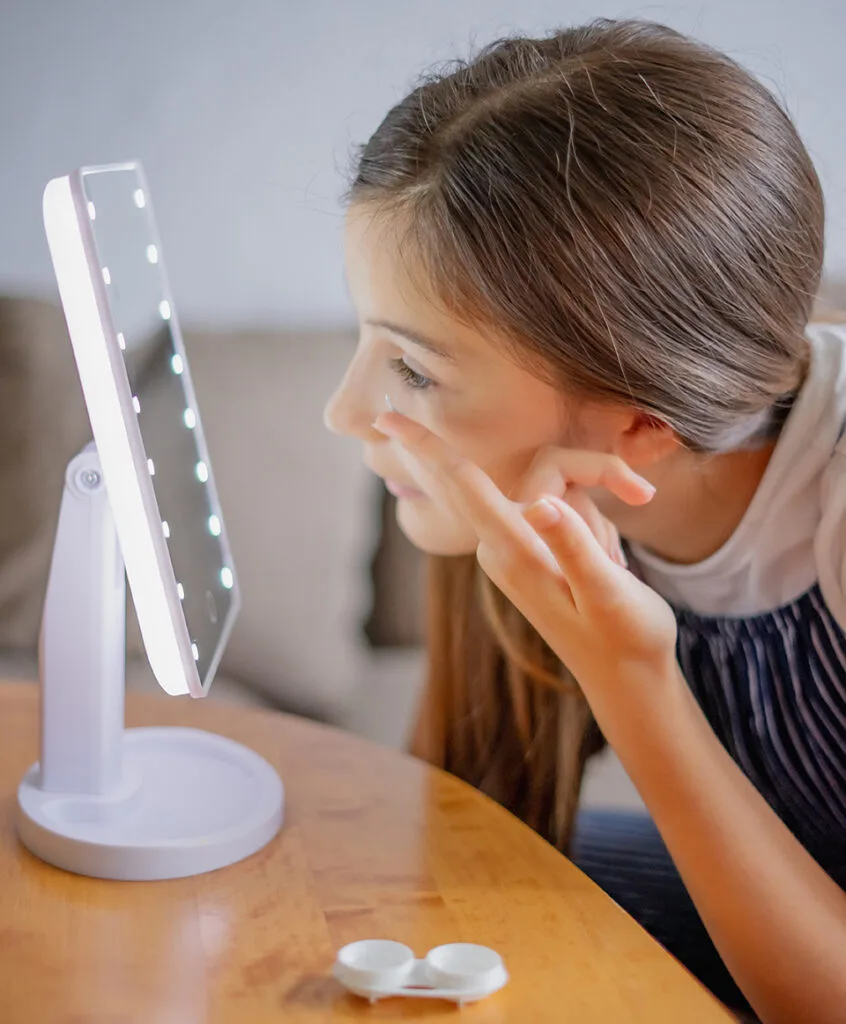
Contact lenses can be a great option for kids and teens.
They can help with sports, confidence, side vision, dance, gymnastics, strong prescriptions, and freedom from glasses during certain activities.
But contacts also come with rules.
- Some rules are flexible based on the child, prescription, and lens type.
- Some rules are not.
One of the most important contact lens safety rules is this:
Your child should not sleep, swim, or shower in contact lenses unless the eye doctor has specifically prescribed a lens for that type of wear and explained the safety plan.
For most children and teens, contacts should come out before sleeping, showering, swimming, hot tubs, water parks, and any activity where water can get near the lenses.
This matters because contact lenses sit directly on the eye. If they are worn too long, exposed to water, or used incorrectly, they can increase the risk of eye infection, corneal scratches, inflammation, pain, and in rare cases, vision-threatening complications.
Contact Lenses Are Medical Devices
Contact lenses may feel simple because many people wear them.
But they are medical devices.
They sit on the cornea, which is the clear front surface of the eye. That means contacts need to be prescribed, properly fit, and monitored by an eye doctor.
Your child should not wear contacts from a friend, beauty store, costume shop, online seller without prescription verification, or any source that skips the eye exam.
This includes colored contacts and costume contacts.
Even contacts with no prescription power still touch the eye and still carry risk. A proper contact lens exam and fitting is essential.
Why Sleeping in Contacts Is Risky
Most children should not sleep in contacts.
When your child sleeps in contact lenses, the eye gets less oxygen. The lens can also trap debris, bacteria, and irritation against the eye surface.
This can increase the risk of corneal infection.
A corneal infection can be painful and serious. In some cases, it can cause scarring or permanent vision problems if not treated quickly.
The FDA notes that eye care professionals generally do not recommend extended-wear lenses for kids and teens because they can increase the incidence of corneal ulcers.
That is why the usual rule is simple:
Contacts come out before sleep.
What About a Short NAP?
A short nap is still sleeping.
Your child should not nap in contacts unless the doctor has specifically said the lens is approved and appropriate for that type of wear.
This matters because many contact lens mistakes happen accidentally.
- A teen lies down after school.
- A child falls asleep in the car after a tournament.
- A dancer falls asleep after a long rehearsal.
- A child naps during travel.
If contacts are in, the risk increases.
The best habit is to remove contacts before resting when there is any chance your child may fall asleep.
What If My Child Accidentally Sleeps in Contacts?
Do not panic, but do not ignore it.
Have your child wash their hands first.
If the lenses feel dry or stuck, do not force them off. You may need to use contact lens approved lubricating drops and wait a few minutes.
Once the lenses are removed, your child should wear glasses for the day if the eyes feel irritated.
Call the eye doctor right away if your child has:
- Eye pain
- Redness
- Light sensitivity
- Blurry vision
- Discharge
- Excess tearing
- A white spot on the eye
- Trouble keeping the eye open
- Symptoms that continue after the lens is removed
A painful red eye after sleeping in contacts should be checked promptly.
Why Swimming in Contacts Is Risky
Contact lenses and water do not mix.
This includes pool water, ocean water, lake water, river water, hot tubs, splash pads, and water parks.
Water can contain germs that may attach to contact lenses or become trapped between the lens and the eye.
One serious infection associated with water exposure is Acanthamoeba keratitis. It is rare, but it can be severe and difficult to treat.
Swimming in contacts also increases the chance that a lens will move, fall out, trap debris, or irritate the eye.
If your child needs to see clearly in the water, contacts are usually not the safest solution.
Ask about prescription swim goggles instead.
What About Swimming Goggles over Contacts?
Some families ask if goggles make swimming in contacts safe.
Goggles may reduce water exposure, but they do not guarantee that water will stay out.
Kids jump, splash, dive, rub their eyes, adjust goggles, and play hard. Water often leaks in.
For that reason, the safer recommendation is usually to remove contacts before swimming and use prescription swim goggles when vision correction is needed.
If your child is a competitive swimmer or has a special situation, talk with the eye doctor before deciding.
Do not make a water plan on your own.
What If My Child Swims in Contacts by Accident?
Have your child remove the contacts as soon as possible.
- If they are daily disposable lenses, throw them away.
- If they are reusable lenses, ask your eye doctor what to do. Many doctors may recommend discarding the lenses rather than trying to reuse them after water exposure.
Have your child wear glasses afterward.
Call the eye doctor right away if your child has:
-
Eye pain
-
Redness
-
Light sensitivity
-
Blurry vision
-
Excess tearing
-
Discharge
-
A gritty feeling that does not go away
-
Symptoms that worsen over the next day
-
Do not put the same lenses back in after swimming.
-
Do not rinse lenses with tap water.
-
Do not sleep in the lenses after water exposure.
Why Showering in Contacts Is Risky
Shower water is not sterile.
Tap water can contain microorganisms that should not be trapped against the eye by a contact lens.
When your child showers in contacts, water can splash into the eyes, get under the lenses, and increase infection risk.
This is true even if the shower looks clean.
It is also true even if your child keeps their eyes closed.
The safest plan is to remove contacts before showering.
What About Washing the Face with Contacts In?
This is also risky if water gets near the eyes.
Kids often splash water on their face, rub their eyes, or get soap and water near the lashes.
If your child wears contacts, teach them to be careful with face washing.
The safest order is often:
- Wash face before inserting contacts in the morning
- Remove contacts before washing face at night
- Avoid getting water or soap in the eyes while contacts are in
If your child uses acne products, makeup remover, cleanser, sunscreen, or soap around the eyes, contacts may also become irritated.
What About Hot Tubs?
Hot tubs are especially important to avoid with contacts.
Warm water can contain organisms that increase infection risk, and hot tubs can splash water into the eyes.
Contacts should come out before hot tubs.
This rule applies even if your child does not plan to put their face underwater.
Steam, splashing, and wet hands can all create problems.
What About Water Parks and Splash Pads?
Water parks and splash pads are also contact lens risk zones.
Kids run through sprays, splash each other, rub their eyes, and get water in the face repeatedly.
Contacts should not be worn in these settings unless the eye doctor has specifically made a plan.
Prescription swim goggles may be a better option when vision correction is needed.
What About the Beach?
Beach days combine several contact lens challenges:
- Ocean water
- Sand
- Sunscreen
- Sweat
- Wind
- Bright sun
- Eye rubbing
- Long wear time
- Dryness
- Napping on the way home
If your child wears contacts at the beach, they should not go in the water with them.
They should also have sunglasses, backup glasses, and clean hands before touching lenses.
For many children, prescription sunglasses or prescription swim goggles are safer for beach days.
What About Sports Tournaments?
Sports tournaments are a common time for contact lens mistakes.
Kids wear contacts for long hours, sweat, use sunscreen, touch their eyes with dirty hands, nap between games, or sleep in contacts after a long day.
If your child wears contacts for sports, pack:
- Backup glasses
- Extra daily contact lenses
- Contact lens solution if reusable lenses are worn
- Contact lens case if reusable lenses are worn
- Contact lens safe lubricating drops if recommended
- Sunglasses
- Hand washing supplies when possible
- A plan for removing lenses before naps or sleep
Your child should never keep contacts in just because there is another game later.
The Red Eye Rule
Every child and teen who wears contacts needs to know this rule:
If the eye is red, painful, light sensitive, or blurry, the contact lens comes out.
Then call the eye doctor.
- Do not put in another lens.
- Do not wear contacts to school, practice, a game, or a performance with a painful red eye.
- Do not use old prescription drops.
- Do not wait several days.
A contact lens wearer with eye pain, redness, light sensitivity, or blurry vision should be taken seriously.
Why Backup Glasses Are Required
Every contact lens wearer needs backup glasses.
This is not optional.
Backup glasses are needed when:
- The eye is red
- The eye hurts
- The lens tears
- A lens is lost
- The child has allergies
- The child has dry eye symptoms
- The child has an infection
- The child is sick
- The child is traveling
- The child needs a break from contacts
- The doctor says to stop contacts temporarily
- Contacts are not safe for a water activity
If your child does not have backup glasses, they may keep wearing contacts when they should not.
That creates risk.
Daily Contacts Do Not Make Sleeping or Swimming Safe
Daily disposable contacts are convenient.
They are often a great option for kids because there is no cleaning or storage routine.
But daily contacts still should not be slept in, swum in, showered in, or reused.
- Daily means one day of waking wear, then throw them away.
- It does not mean they are safer in water.
- It does not mean they can be worn overnight.
- It does not mean they can be saved and worn again later.
Monthly Contacts Need Even More Care
Monthly contacts can be safe for responsible children and teens, but they require more steps.
They must be cleaned, disinfected, stored, and replaced correctly.
- Monthly contacts should not be exposed to water.
- They should not be slept in unless specifically prescribed for overnight wear.
- They should not be stretched beyond the replacement schedule.
Children and teens who wear monthly lenses need strong habits and parent oversight.
If your child is likely to take shortcuts, daily contacts may be a better option.
ortho-K Is Different
Ortho-K lenses are designed to be worn overnight.
They are not the same as accidentally sleeping in regular soft contacts.
Ortho-K stands for orthokeratology. These are specially fit rigid lenses worn during sleep and removed in the morning. They gently reshape the front surface of the eye so the child may see more clearly during the day without glasses or daytime contacts.
Ortho-K may also be used as part of myopia management.
Because ortho-K is overnight lens wear, hygiene and follow-up are very important.
A child using ortho-K still should not swim or shower in the lenses.
Parents should not confuse prescribed ortho-K wear with sleeping in regular contacts.
They are different situations with different rules.
What If My Child Uses Myopia Management Contacts?
Some children wear contact lenses as part of myopia management.
These may include daily disposable myopia control lenses or ortho-K lenses.
The safety rules still matter.
For daily myopia control lenses:
- Wear during waking hours only
- Throw away after each use
- Do not swim in them
- Do not shower in them
- Do not sleep in them
- Keep backup glasses available
For ortho-K:
- Wear only as prescribed
- Remove in the morning
- Clean exactly as directed
- Do not expose lenses to water
- Keep all follow-up visits
- Call with pain, redness, light sensitivity, or blur
Myopia management works best when the treatment is used safely and consistently.
What If My Teen Says Everyone Sleeps in Contacts?
This is common.
Teens often hear that friends sleep in contacts and are fine.
That does not make it safe.
Some contact lens complications are rare, but when they happen, they can be serious.
A teen may get away with bad habits many times before one bad infection occurs.
The goal is not to scare them.
The goal is to make the rule clear:
Contacts are a privilege that requires responsibility.
If they cannot follow the safety rules, they may not be ready for contacts.
What If My Child Refuses Glasses and Wants Contacts All the Time?
Contacts can be a good option, but every contact lens wearer still needs glasses.
Even if your child hates glasses, they need a current pair.
There will be days when contacts are not safe.
Examples include:
- Red eye
- Eye infection
- Corneal scratch
- Allergies
- Dryness
- Lost lenses
- Swimming
- Showering
- Illness
- Travel delays
- Supply problems
A child who refuses glasses may need help choosing a more comfortable or better-looking backup pair.
But they still need one.
What If My Child Wears Contacts to School and Has Gym or Swimming?
This needs a plan.
- For regular gym class, contacts may be fine if the child follows safety rules.
- For swimming, contacts should not be worn in the pool.
If school includes swimming, tell the teacher or school nurse that your child wears contacts and needs a safe plan.
Options may include:
- Wearing glasses on swimming days
- Using prescription swim goggles
- Removing contacts before swimming
- Bringing backup glasses
- Using daily lenses only after swimming is finished
Do not assume your child will figure it out alone at school.
What If Contacts Get Wet from Rain?
Rain exposure is usually less risky than swimming or showering because the eye is not submerged and water is not usually trapped under the lens in the same way.
But children should still avoid rubbing wet eyes or handling contacts with wet hands.
If rainwater, debris, or irritation gets in the eye and the lens becomes uncomfortable, the lens should come out.
If pain, redness, light sensitivity, or blur continues, call the eye doctor.
What About Crying with Contacts?
Crying with contacts is usually not a problem.
Tears are not the same as tap water, pool water, or lake water.
The bigger issue is rubbing the eyes.
If your child cries while wearing contacts, remind them not to rub. If the lenses feel uncomfortable afterward, they can remove them and wear glasses.
What About Eye Drops?
Only use drops that are safe for contact lenses.
Not all drops can be used while lenses are in.
Some allergy drops, redness drops, and medicated drops require contacts to be removed.
Ask the eye doctor exactly which drops your child can use and when.
Avoid regular redness reliever drops unless the eye doctor recommends them.
They can hide symptoms without treating the cause.
What About Makeup and Contacts?
For teens wearing contacts and makeup, the order matters.
Usually, contacts go in before makeup and come out before makeup removal, but your eye doctor should give specific instructions.
- Avoid glitter near the eyes.
- Avoid sharing eye makeup.
- Avoid applying eyeliner inside the lid margin unless advised.
- Remove contacts if makeup gets under the lens or the eye becomes irritated.
- Never sleep in contacts after wearing makeup.
What About Sunscreen?
Sunscreen can sting badly if it gets in the eye.
With contacts, that irritation can feel worse.
Your child should wash hands after applying sunscreen and before touching contacts.
For outdoor sports, apply sunscreen carefully around the eyes and consider hats or sunglasses.
If sunscreen gets in the eye and the contact becomes uncomfortable, remove the lens.
Call if pain, redness, light sensitivity, or blurry vision continues.
What Should Parents Pack for Travel?
For travel, pack more than you think you need.
Bring:
- Backup glasses
- Extra contact lenses
- Contact lens case
- Travel-size solution if reusable lenses are worn
- Contact lens safe lubricating drops if recommended
- A copy or photo of the prescription
- Sunglasses
- Hand washing supplies
- A plan for flights, naps, pools, and beach days
Do not pack all contacts and glasses in checked luggage.
Keep backup vision correction accessible.
What If My Child Wears Contacts on a Plane?
Contact lenses can feel dry on planes.
Cabin air is dry, and children may nap during flights.
If your child is likely to sleep, glasses may be better for travel.
If they wear contacts on the plane, remind them not to sleep in them and to use only doctor-approved lubricating drops if needed.
For long flights, glasses are often the safer and more comfortable choice.
How to Teach the Safety Rules
Children need simple rules they can remember.
You can teach:
- No sleeping in contacts
- No swimming in contacts
- No showering in contacts
- No water on contacts
- No sharing contacts
- No wearing contacts with a red or painful eye
- No reusing daily lenses
- No stretching monthly lenses
- Wash and dry hands first
- Always have backup glasses
Do not assume one explanation is enough.
Review the rules often.
What If My Child Breaks the Rules?
Stay calm.
Ask what happened.
- Were they embarrassed to wear glasses?
- Did they forget supplies?
- Did they fall asleep?
- Did they not understand the rule?
- Did they not want to miss practice?
Then fix the system.
- Maybe they need backup glasses in their sports bag.
- Maybe daily lenses are better than reusable lenses.
- Maybe they are not ready for contacts yet.
- Maybe they need a clearer routine before bed.
The goal is not punishment.
The goal is prevention.
When to Call the Eye Doctor Urgently
Call promptly if your child wears contacts and has:
- Eye pain
- Redness
- Light sensitivity
- Blurry vision
- Discharge
- Excess tearing
- Swelling
- A white spot on the eye
- Trouble keeping the eye open
- Symptoms after sleeping in contacts
- Symptoms after swimming or showering in contacts
- A torn lens that may have scratched the eye
- Symptoms that do not improve after removing the lens
Do not wait to see if a contact lens eye problem goes away.
What the Eye Doctor May Check
If your child has a contact lens concern, the eye doctor may check:
- Vision
- Corneal health
- Redness
- Scratches
- Infection signs
- Lens fit
- Tear film
- Allergies
- Contact lens hygiene habits
- Replacement schedule
- Whether contact lens wear should pause
- Whether medication is needed
Sometimes the child needs to stop contacts temporarily.
That is another reason backup glasses matter.
Contact Lens Safety at Pediatric & Family Vision
At Pediatric & Family Vision, we help children and teens wear contact lenses safely.
We talk with families about the real-life situations where kids make mistakes: sleeping after tournaments, swimming at parties, showering after practice, wearing contacts too long, forgetting backup glasses, or hiding red eye symptoms because they do not want to stop contacts.
We do not want families scared of contact lenses.
We want them prepared.
Contacts can be a great option for the right child.
But they require responsibility.
If your child is wearing contacts or asking to start, we will help you understand the lens options, wearing schedule, cleaning routine, water rules, sports plan, and what symptoms mean the lenses need to come out.
The most important rule is simple:
If the eye is red, painful, light sensitive, or blurry, contacts come out and you call the eye doctor.