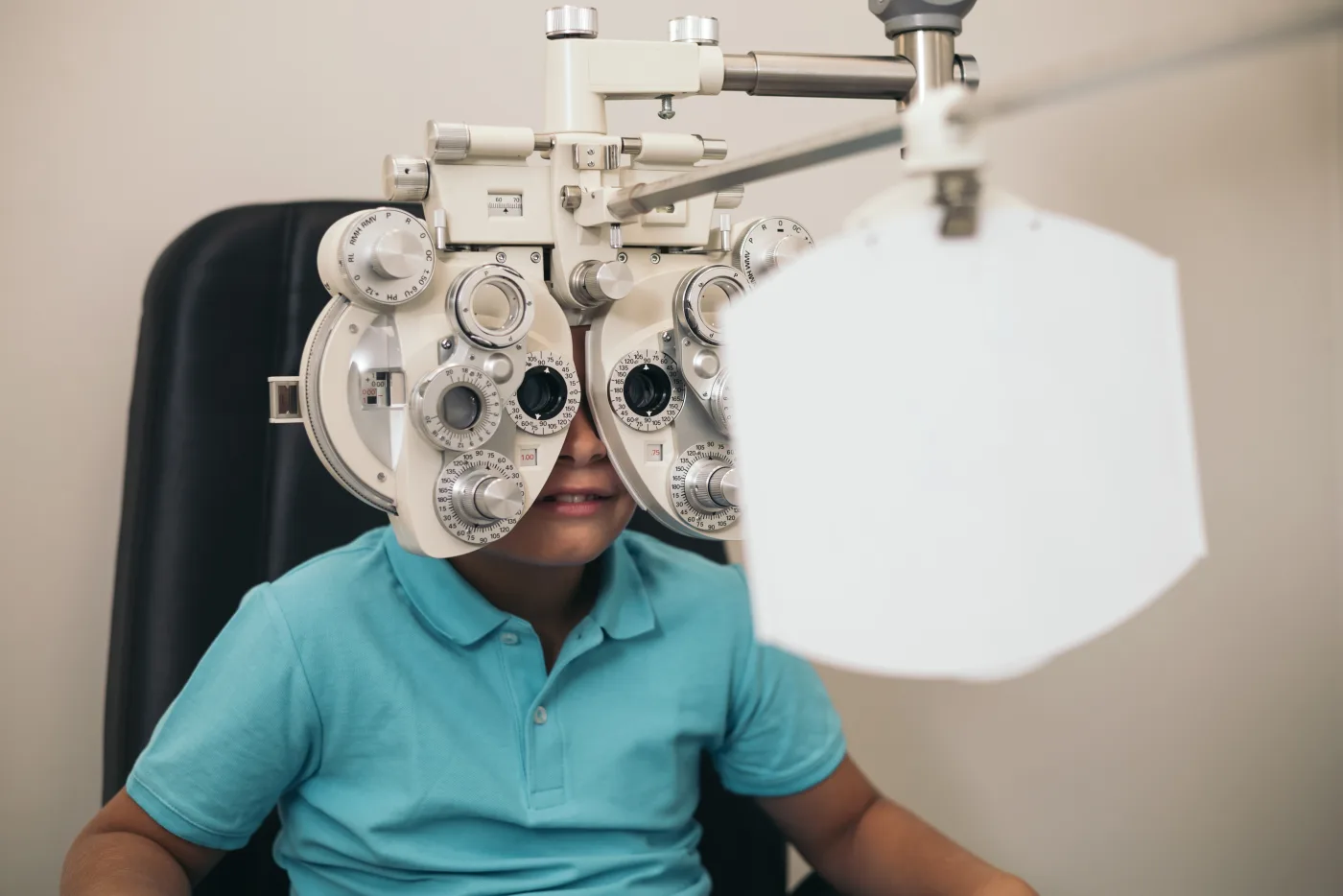
Scheduling your child’s first eye exam can feel a little confusing if you do not know what to expect.
Parents often wonder if their child needs to know letters, sit perfectly still, answer questions, or understand what the doctor is asking. The good news is that a pediatric eye exam is designed around your child’s age, attention span, and comfort level.
Your child does not need to be perfect at the visit.
They do not need to know all their letters. They do not need to describe their vision clearly. They do not need to behave like a little adult.
A good pediatric eye exam should meet your child where they are.
The goal is to check eye health, vision, prescription, eye alignment, focusing, and how the eyes are developing in a way that feels calm and manageable for your child.
Why Your Child’s First Eye Exam Matters
Many parents think an eye exam is only needed if a child fails a school screening or says they cannot see.
But children do not always know how to explain vision problems.
A child may assume everyone sees the way they do. They may not know the board is supposed to look clearer. They may not realize reading should not make their eyes tired. They may not understand that closing one eye, losing their place, or getting headaches during homework could be related to vision. (Read more about signs your child might need glasses.)
A first eye exam helps answer important questions.
- Can your child see clearly?
- Do they need glasses?
- Are both eyes developing evenly?
- Are the eyes healthy?
- Are the eyes working together?
- Is there anything that needs to be watched over time?
For many children, the exam is normal. That is still valuable. It gives you a baseline and helps you know what to watch for as your child grows.
Is This Different from a School Vision Screening?
Yes.
School vision screenings are helpful, but they are not the same as a comprehensive eye exam.
A screening is usually a quick check to identify children who may need further evaluation. Many screenings focus mostly on distance vision. Some may use photoscreening or other tools. The exact process can vary by school, age, and program.
A comprehensive eye exam looks more closely at the full visual system.
It may include vision clarity, glasses prescription, eye health, eye alignment, focusing, depth perception, and how the eyes work together.
That is why a child can pass a screening and still need a full eye exam.
What Age Can a Child Have an Eye Exam?
Children can have eye exams at any age.
Babies, toddlers, preschoolers, school-age children, and teens can all be examined. The testing simply changes based on the child’s age and developmental level.
A baby may be checked with lights, lenses, movement, and observation.
A toddler may identify pictures or match shapes.
A preschooler may point, name pictures, or play simple vision games.
An older child may read letters, answer comparison questions, and complete more detailed testing.
Your child does not need to read letters for the doctor to learn a lot about their eyes.
How to Prepare Your Child for the Visit
You do not need to overprepare.
In fact, too much explaining can sometimes make children more nervous. A simple explanation is usually best.
You can say:
“The doctor is going to check how your eyes are working. You may look at pictures, lights, letters, or toys. Nothing is scary. I will be with you.”
Try to avoid saying things like:
“It will not hurt.”
This can accidentally make children wonder if something might hurt.
Instead, keep it simple and calm.
Before the visit, it can help to bring:
- Your child’s current glasses, if they have any
- Any previous eye exam records, if available
- A list of medications
- Your insurance cards
- Any school screening results
- Notes from teachers, therapists, or pediatricians
- A list of symptoms you have noticed
- A favorite small toy or comfort item for younger children
If your child has had headaches, reading struggles, eye rubbing, squinting, or trouble seeing the board, write down when it happens. That detail helps.
What Happens at the Beginning of the Exam?
The visit usually starts with questions.
The doctor or technician may ask about your child’s health history, birth history, family history, school performance, screen use, reading comfort, and any symptoms you have noticed.
Common questions may include:
- Does your child squint?
- Does your child sit close to the TV?
- Does your child rub their eyes?
- Does your child complain of headaches?
- Does your child avoid reading?
- Does one eye ever turn in or out?
- Has your child had a concussion or eye injury?
- Is there a family history of glasses, lazy eye, eye turns, or eye disease?
- Did your child fail a school vision screening?
- Is there concern about attention, reading, or copying from the board?
These questions help guide the exam.
Sometimes the symptom pattern is just as important as the eye chart.
How the Doctor Checks Vision
The way vision is checked depends on your child’s age.
Older children may read letters or numbers on a chart.
Younger children may name pictures, match shapes, or point to matching symbols.
Very young children may be checked by how they look at targets, follow objects, or respond to different lenses and lights.
The doctor is looking at how clearly each eye sees, whether one eye sees better than the other, and whether vision is appropriate for your child’s age.
This part of the exam helps identify concerns like nearsightedness, farsightedness, astigmatism, or reduced vision in one eye.
How the Doctor Checks for Glasses
Parents are often surprised that we can estimate a child’s prescription even if they are unsure of their answers.
Eye doctors can use lenses and light to measure how the eye focuses. This helps determine whether your child may need glasses, even if your child is too young to reliably answer, “Which is better, one or two?”
Some children need glasses to see far away.
Some need glasses to see clearly and comfortably up close.
Some have astigmatism, which can make vision blurry or distorted at more than one distance.
Some have a prescription difference between the two eyes, which can affect how vision develops.
Not every prescription needs glasses right away. The doctor will explain whether the prescription is normal for your child’s age, something to monitor, or something that should be corrected.
Will My Child Need Eye Drops?
Sometimes.
Eye drops may be used to dilate the pupils or relax the focusing system so the doctor can get a more accurate look at the prescription and eye health.
Not every child needs dilation at every visit, but it is common in pediatric eye care, especially for first exams, young children, high prescriptions, eye turns, reduced vision, or when the doctor needs a better view of the inside of the eye.
If drops are used, your child may be light sensitive afterward and near vision may be blurry for a few hours. Sunglasses can help.
The doctor will explain why drops are recommended if they are needed.
How the Doctor Checks Eye Health
A child’s eye exam is not only about glasses.
The doctor also checks the health of the eyes.
This may include looking at the front of the eyes, the pupils, the eye muscles, and the inside of the eyes.
The doctor is checking for signs of eye disease, inflammation, injury, congenital concerns, cataracts, retinal problems, or other health issues that can affect vision.
Most children have healthy eyes. But this part of the exam matters because some eye health problems do not cause obvious symptoms at first.
How the Doctor Checks Eye Alignment and Eye Teaming
The doctor will also look at how the eyes aim and work together.
This matters because the two eyes need to coordinate as a team.
If one eye turns in or out, even some of the time, it can affect how the brain uses vision. If the eyes are not teaming comfortably, a child may have symptoms during reading or close work.
The doctor may check whether the eyes are straight, whether they move smoothly, whether they work together at near, and whether your child has depth perception.
If your child has headaches, double vision, eye strain, reading fatigue, or closes one eye, this part of the exam is especially important.
What If My Child Is Shy, Silly, or Uncooperative?
That is normal.
Children are not expected to act perfectly during an eye exam.
Some are shy. Some are silly. Some are tired. Some answer every question with “I do not know.” Some want to sit on a parent’s lap. Some need breaks.
A pediatric exam is flexible.
The doctor can often gather information in more than one way. If your child cannot complete one test, there may be another way to check the same skill.
Parents do not need to feel embarrassed if their child is nervous or wiggly. That is part of working with children.
What If My Child Already Passed a Vision Screening?
That is helpful information, but it does not replace a full eye exam.
A child can pass a screening and still have symptoms during reading, focusing, eye teaming, or sustained near work.
If your child has never had a comprehensive eye exam, has symptoms, or has a family history of vision problems, it is still reasonable to schedule.
What If My Child Needs Glasses?
If your child needs glasses, the doctor will explain why.
This matters because children may need glasses for different reasons.
Some children need glasses to see the board.
Some need glasses to reduce strain.
Some need glasses because one eye has a stronger prescription than the other.
Some need glasses to support normal visual development.
The prescription is not just a number. It tells us how your child’s eyes are focusing and whether correction may help their vision, comfort, or development.
If glasses are recommended, the next step is choosing frames that fit properly, stay on well, and match your child’s daily needs.
What If the Exam Is Normal?
That is a good outcome.
A normal exam can give you peace of mind. It can also help you know that symptoms like reading trouble, headaches, or school concerns may need to be explored from another angle.
Sometimes parents worry that they are wasting time by scheduling an exam if nothing is wrong.
You are not.
Ruling out vision problems is useful information.
When More Testing May Be Needed
Sometimes a routine eye exam shows that a child needs more detailed testing.
This may happen if your child has symptoms like:
- Losing place while reading
- Skipping words or lines
- Frequent headaches with reading
- Double vision
- Eye strain
- Trouble copying from the board
- Poor depth perception
- Eye teaming problems
- A history of concussion
- Visual symptoms that do not match a simple glasses prescription
In those cases, the doctor may recommend a more detailed developmental vision evaluation or binocular vision evaluation.
This does not mean every child needs extra testing. It means the first eye exam helps decide what level of care is appropriate.
How Long Does a Child’s First Eye Exam Take?
The length of the visit can vary.
A simple routine exam may be shorter. A first pediatric exam may take longer if the child is young, nervous, has symptoms, needs dilation, or has a more complex history.
It is best not to schedule the exam during nap time or right before another rushed activity if your child is young.
A calm child who is not hungry or exhausted usually has an easier visit.
First Eye Exams at Pediatric & Family Vision
At Pediatric & Family Vision, we see babies, children, teens, and adults for primary eye care.
For children, we try to make the first exam calm, clear, and age-appropriate. We check vision, eye health, prescription, eye alignment, focusing, and how the eyes are working together. See our new-patient page for what to bring and how to prepare.
If your child needs glasses, we will explain why. If the exam is normal, we will tell you that too. If your child has symptoms that suggest something more detailed is needed, we will help guide the next step.
Your child does not need to read letters perfectly or explain everything they feel.
That is our job to figure out.
If your child has never had a full eye exam, or if you have noticed squinting, headaches, eye rubbing, reading fatigue, or trouble seeing the board, a comprehensive eye exam is a good place to start.