School vision screenings are helpful. They give schools a way to catch children who may have trouble seeing the board, reading at a distance, or recognizing letters on a chart.
But a school vision screening is not the same as a comprehensive eye exam.
This is where many parents get confused. A child may pass a school screening and still have a vision problem that affects reading, attention, comfort, headaches, or how well the eyes work together up close.
That does not mean the school did anything wrong. It means the screening was designed to do one job, and a full eye exam is designed to do much more.
What Does a School Vision Screening Usually Check?
Most school screenings are designed to be quick. They often check how clearly a child can see letters or shapes from far away.
That is important. Distance vision matters for seeing the board, reading signs, watching demonstrations, and participating in class.
But schoolwork is not only done far away.
Most of a child’s learning happens up close. Reading, writing, worksheets, tablets, laptops, art projects, and homework all require the eyes to focus, aim, move, and work together at near distance.
A child can pass a distance vision screening and still struggle with the visual skills needed for reading and learning.
Why Passing a Screening Does Not Always Mean Everything Is Fine
A screening is meant to identify possible problems. It is not meant to diagnose every vision issue.
Think of it like a quick hearing check at school. If a child passes, that is reassuring. But if the child still struggles to hear in noise, follow directions, or process what was said, a more complete evaluation may still be needed.
Vision works the same way.
Passing a school vision screening usually means your child met the screening criteria that day. It does not always mean:
- Both eyes are working together comfortably
- The eyes can focus up close for long periods
- The eyes can move smoothly across a page
- The child has no eye strain
- The child has no prescription
- The child has no eye health concerns
- The child has no vision-related reason for headaches or fatigue
It simply means they passed the test that was given.
What School Screenings Can Miss
Every school is different, and screening methods vary. Some schools use letter charts. Some use photoscreeners. Some check both near and distance. Some only check distance. Some screenings are done by trained screeners, and some are done quickly as part of a large group process.
Because of that, what gets missed can vary.
Common things that may be missed include:
- Farsightedness
- Eye focusing problems
- Eye teaming problems
- Convergence insufficiency
- Subtle eye turns
- Depth perception problems
- Eye tracking problems
- Vision problems that only show up after sustained reading
- Mild or uneven prescriptions
- Eye strain related to screens or near work
Some of these problems do not always show up when a child is asked to read a distance chart for a few seconds.
They may show up after 10 minutes of reading. Or after a full school day. Or during homework when the child is tired and trying to keep both eyes focused on a page.
The Child Who “Sees Fine” but Still Struggles
This is very common.
A parent may say:
“My child passed the school screening.”
“My child can see tiny things across the room.”
“My child has 20/20 vision.”
“My child never complains that things are blurry.”
And all of that may be true.
But the child may still lose their place when reading. They may avoid homework. They may rub their eyes. They may get headaches. They may read the same line twice. They may skip words. They may become tired, frustrated, or distracted during near work.
This is why vision is not only about seeing clearly far away.
Comfort matters. Stamina matters. Eye teaming matters. Focusing matters. Tracking matters. Visual development matters.
Why Children Do Not Always Complain
Adults usually know how to describe symptoms. A child often does not.
A child may not say:
“My eyes are not working together.”
“My focusing system gets tired.”
“The words blur after I read for a while.”
Instead, they may say:
“I do not like reading.”
“My head hurts.”
“I am tired.”
“This is boring.”
“I do not want to do homework.”
They may rush through schoolwork, avoid reading, act silly, get emotional, or seem inattentive.
That does not mean every reading or attention concern is a vision problem. But it does mean vision should be considered, especially when a child has symptoms during reading, writing, homework, or screen use.
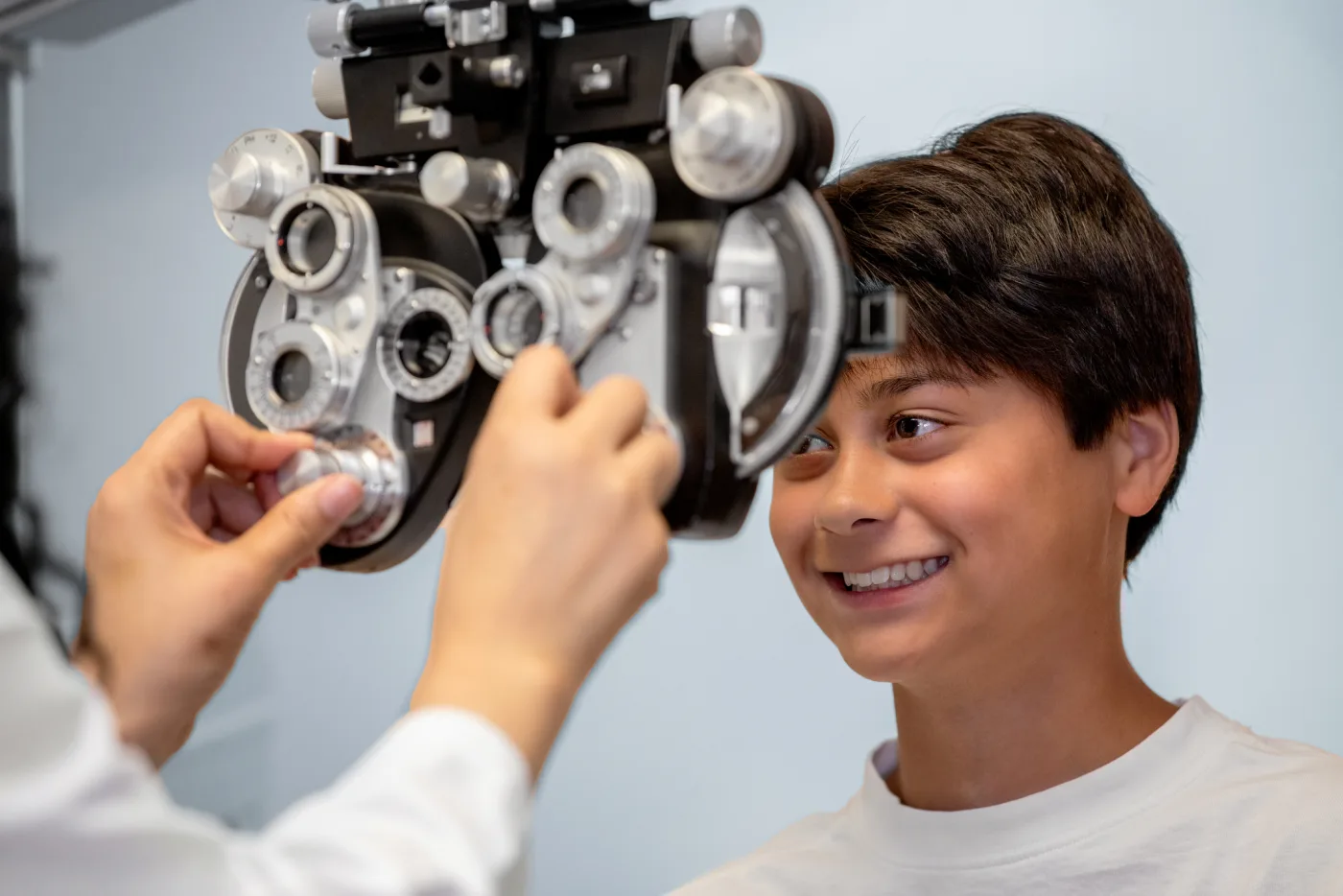
What a Comprehensive Eye Exam Checks That a Screening May Not
A comprehensive eye exam looks at more than whether your child can read letters on a chart.
Depending on the child’s age and symptoms, an eye exam may check:
- Visual acuity
- Eye health
- Glasses prescription
- Eye alignment
- Eye movement
- Eye focusing
- How the eyes work together
- Depth perception
- Pupil responses
- Signs of eye disease or injury
- Visual comfort at distance and near
- Whether a more detailed developmental vision evaluation is needed
For many children, the answer is simple. They may need glasses, an updated prescription, or reassurance that the eyes are healthy.
For other children, especially those with reading strain, headaches, double vision, or tracking concerns, a more detailed look at binocular vision and visual skills may be needed.
When Should Your Child Have an Eye Exam Even If They Passed the School Screening?
Schedule a comprehensive eye exam if you notice:
- Squinting
- Sitting too close to the TV
- Holding books or tablets very close
- Frequent headaches
- Eye rubbing
- One eye closing or covering one eye
- Losing their place while reading
- Skipping words or lines
- Avoiding reading
- Homework taking much longer than expected
- Blurry vision
- Double vision
- Trouble copying from the board
- Poor attention during near work
- A drop in school performance
- Light sensitivity
- A family history of childhood vision problems
You should also schedule an exam if your child has never had a full eye exam before. (Not sure when that should be? See our article on when your baby should have their first eye exam.)
A school screening can be a helpful checkpoint, but it should not be the only time your child’s vision is evaluated.
Are School Screenings Still Useful?
Yes. School screenings are useful.
They can help identify children who need care and may not otherwise be seen. They are especially important for children who have not had regular eye exams.
But screenings have limits.
The problem is not that screenings exist. The problem is when parents are told, or assume, that passing a screening means the child definitely has no vision problem.
A better way to think about it is this:
A school vision screening is a starting point. A comprehensive eye exam is the full evaluation.
What If the School Says My Child Failed the Screening?
If your child fails a school vision screening, schedule a comprehensive eye exam.
A failed screening does not automatically mean something serious is wrong. It means your child needs a full exam to find out what is happening.
They may need glasses. They may have trouble with one eye more than the other. They may have an eye alignment concern. They may have been tired, distracted, or unsure during the screening.
The eye exam gives you the answer.
What If My Child Passed but I Still Feel Something Is Off?
Trust that feeling.
Parents often notice things before a screening catches them.
If reading is harder than it should be, if homework causes battles, if your child complains of headaches, or if you notice eye rubbing, squinting, or avoidance, it is reasonable to schedule an eye exam.
You are not overreacting. You are getting more information.
Sometimes the exam shows everything is healthy and working well. That is helpful too. It lets you look at other possible causes with more confidence.
Why This Matters for Learning
Children use their eyes all day at school.
They look across the room, shift back to their desk, read small print, copy from the board, write, use screens, track across lines of text, and sustain near focus for long periods.
If the eyes are not seeing clearly or working comfortably, school can feel harder than it needs to feel.
This does not mean vision is the cause of every learning problem. It is not.
But vision is one piece that should be checked, especially when symptoms show up during reading, writing, or homework.
Eye Exams at Pediatric & Family Vision
At Pediatric & Family Vision, we provide comprehensive eye exams for babies, children, teens, and adults.
For children, we look beyond whether they can read the smallest line on the chart. We check eye health, prescription, eye alignment, focusing, tracking, and how the eyes are working together.
If your child only needs routine care, glasses, or monitoring, we will explain that clearly. If your child has symptoms that suggest a more detailed developmental vision evaluation may be needed, we will walk you through that next step too. See our new-patient page for what to bring and what to expect at the first visit.
A school vision screening is helpful, but it is not the whole picture.
If your child passed a screening but still struggles with reading, headaches, blurry vision, eye strain, or homework fatigue, a comprehensive eye exam is a good place to start.