Lazy Eye and Amblyopia Care in Boca Raton.
Amblyopia is one of the most treatable vision problems in childhood when it is found early. We find it, explain it, and build a treatment plan your family can actually follow.
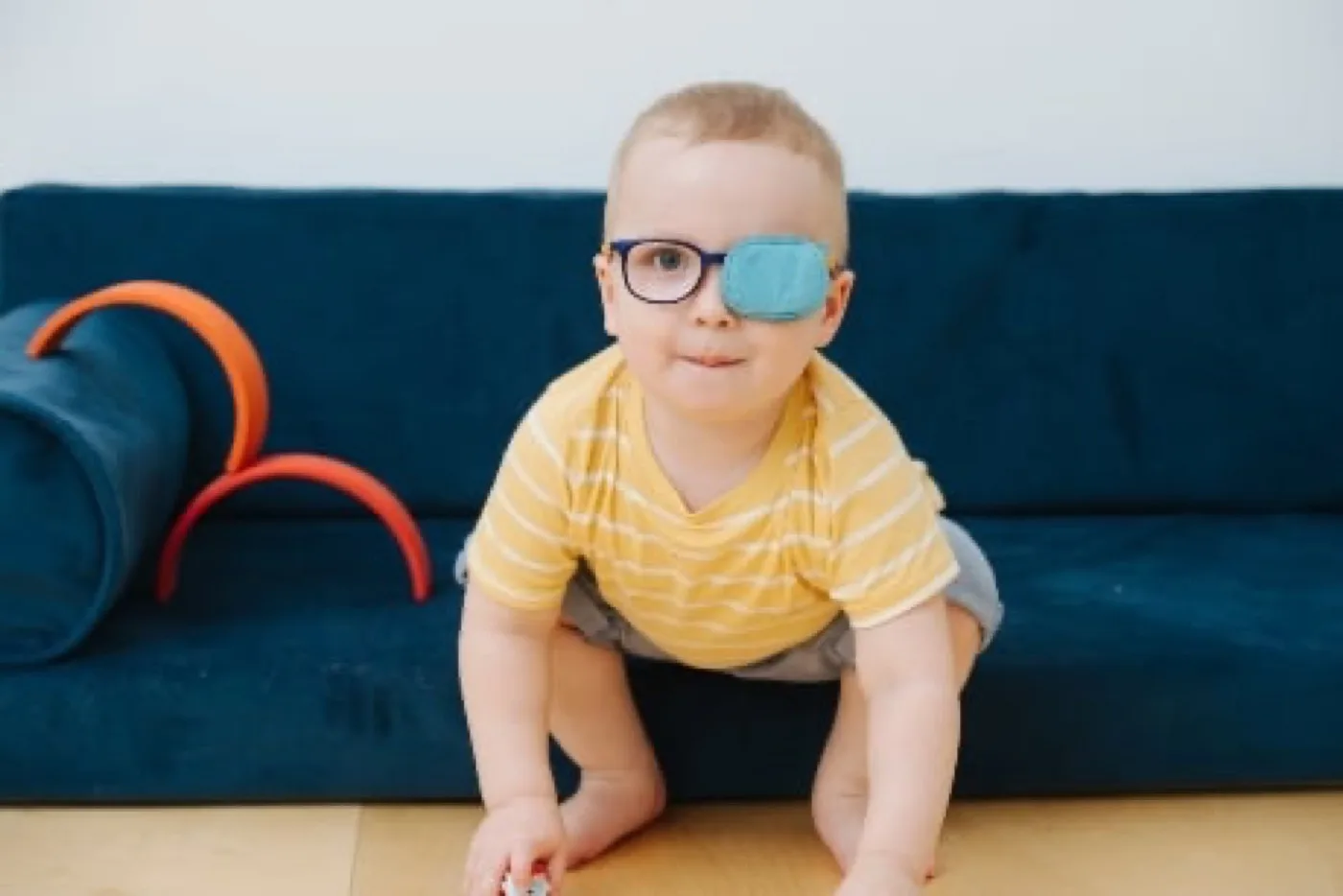
What Is Amblyopia?
Amblyopia, usually called lazy eye, is reduced vision in one eye (and less often both) that starts in childhood. The eye itself often looks completely healthy. The problem is in the connection between the eye and the brain: during the years when vision is developing, the brain gets a clearer picture from one eye and learns to favor it.[1][3]
The weaker eye isn't lazy in the usual sense. It just never got the clear signal it needed to build sharp vision. Up to 3 out of 100 children have amblyopia,[1] and AAPOS calls it the main reason children lose vision.[2]
Is a Lazy Eye the Same as an Eye Turn?
This is the question parents ask me most. An eye turn is called strabismus: one eye points in, out, up, or down while the other looks straight ahead. A turned eye can cause amblyopia, because the brain ignores the misaligned eye to avoid seeing double.[3]
But the two are not the same thing. A child can have an eye turn without amblyopia, and a child can have amblyopia with eyes that look perfectly straight. That second group is the one that worries me, because nothing looks wrong from the outside. If you have noticed an eye that drifts, our binocular vision evaluation looks closely at alignment and eye teaming.
The Three Types of Amblyopia
Each type has a different cause, and the cause shapes the treatment plan.
Refractive Amblyopia
The most common type. One eye needs much more prescription than the other (anisometropia), or both eyes have a high prescription that was never corrected. The brain leans on the clearer eye.
Strabismic Amblyopia
An eye turns in, out, up, or down. To avoid double vision, the brain starts ignoring the turned eye, and that eye stops developing sharp vision.
Deprivation Amblyopia
Rare but urgent. Something blocks light from reaching the back of the eye, such as a cataract, a droopy eyelid, or a scar on the cornea.
Types as described by the American Association for Pediatric Ophthalmology and Strabismus.[2]
Why Lazy Eye Is So Often Missed
Most children with amblyopia never complain. If one eye sees clearly, the world looks normal to them, and they have no idea the other eye is blurry. Parents usually can't tell either, unless there is a visible eye turn.[3] Often a problem is only found with a vision test.[2]
When there are clues, they can include:[1]
- An eye that drifts in or out, especially when tired
- Squinting, shutting one eye, or tilting the head
- Poor depth perception: trouble catching a ball, misjudging steps
- Getting upset, peeking, or pulling away when the stronger eye is covered[3]
- A failed vision screening at school or the pediatrician's office
A child can pass a screening and still have amblyopia, which is why I recommend a full exam rather than a screening alone. Here is more on the difference between a screening and an eye exam, and on exams for toddlers who can't read a chart yet.
How I Diagnose Amblyopia
Vision in Each Eye Separately
With letters, pictures, or matching games for kids who can't read yet. Amblyopia hides when both eyes are open.
Eye Alignment
A cover test shows whether an eye drifts or turns, even a small turn that is hard to see in photos.
Prescription
I measure the exact prescription in each eye, including a large difference between the two that a child would never notice.
Eye Health
A look at the lens, retina, and optic nerve to rule out a cataract or other blockage that needs a different plan.
Depth Perception and Teaming
How well the two eyes work together, which tells me how much the amblyopia is affecting everyday vision.
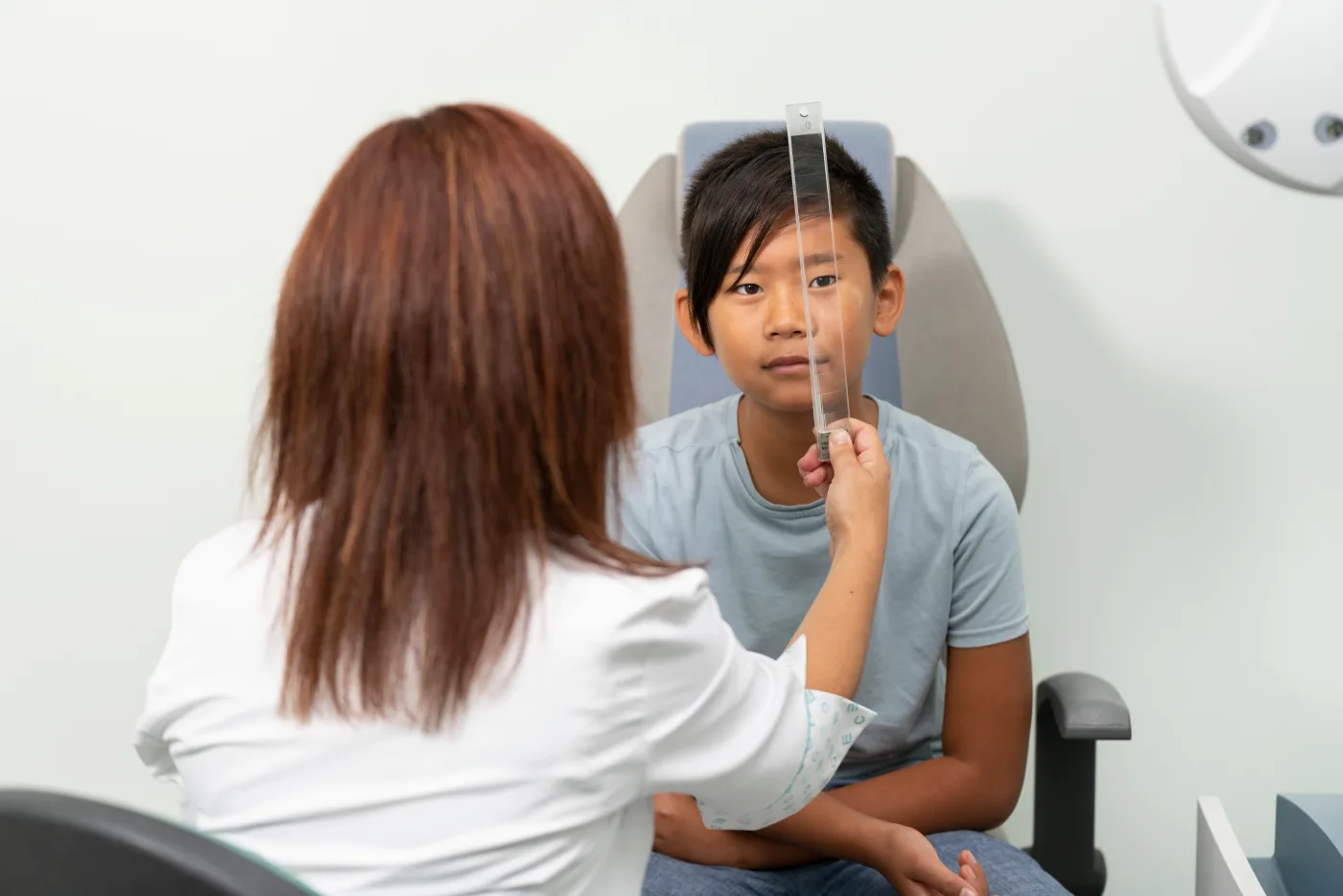
Your child does not need to know letters to be tested. Here is what to expect at a child's first eye exam.
Evidence-Based Lazy Eye Treatment
Much of what we know about treating amblyopia comes from the Pediatric Eye Disease Investigator Group (PEDIG), a national network of eye doctors who run clinical trials in children. Their randomized trials changed how eye doctors treat lazy eye, and they shape the plan I give your family.
Step 1: Glasses First
If a prescription is part of the cause, glasses come first. Wearing the right glasses full time lets the brain finally receive a clear image from the weaker eye, and vision often improves on its own. This is sometimes called refractive adaptation. In a PEDIG study of children 3 to under 7 with amblyopia from unequal prescriptions, glasses alone improved vision by two or more lines in 77% of children and resolved the amblyopia completely in 27%. Improvement took up to 30 weeks to level off.[4] Consistent wear matters, so it helps to know why kids need to wear glasses all day and what to do when a child refuses glasses. Our kids glasses page covers fit and durable lenses.
Step 2: Patching or Atropine Drops
If the weaker eye stops improving with glasses alone, the next step is to make the brain use it. There are two well-studied ways to do that.
Patching covers the stronger eye for part of the day. More hours are not always better. PEDIG found that for moderate amblyopia, 2 hours a day worked as well as 6 hours,[5] and for severe amblyopia, 6 hours a day worked as well as full-time patching,[6] in children 3 to under 7. Some children need only 2 hours a day, and others need more.[1]
Atropine drops are a once-a-day drop that temporarily blurs near vision in the stronger eye, which pushes the brain to use the weaker one. For some children, drops work as well as a patch.[1] In a large trial of children under 7 with moderate amblyopia, patching gave slightly more improvement, but both treatments helped across every age, cause, and severity studied.[7] Drops tend to work less well when the stronger eye is nearsighted or the amblyopia is severe.[2]
Step 3: Follow-Ups and Monitoring
Improvement generally takes several months, and some children need part-time patching for a few years afterward to hold their gains.[3] At each visit I recheck vision in each eye, adjust the plan, and taper treatment when it is safe to do so.
Can Older Children Still Improve?
Yes, often. For years, families were often told there was a strict age cutoff. Treatment does work best in younger children,[2] but a PEDIG trial of 507 children aged 7 to 17 showed that the window does not slam shut.[8]
- Ages 7 to 12: 53% improved two or more lines with patching and atropine, compared with 25% with glasses alone.[9]
- Ages 13 to 17 who had never been treated: 47% improved with patching and near activities, compared with 20% with glasses alone.[9]
Most older children were left with some remaining difference between the eyes,[8] so I am honest with families about what to expect. But if your child is 9 or 14 and was just diagnosed, it is worth an evaluation. If your child is starting school, a back-to-school eye exam is a good time to check.
When glasses, patching and drops have done all they can, or an eye turn keeps the eyes from working together, our sister practice Vision & Learning Center offers specialty amblyopia and strabismus care. I coordinate that referral myself.
When We Refer to a Pediatric Ophthalmologist
Most amblyopia is treated with glasses, patching, or drops. Surgery is sometimes part of the plan for children with an eye turn, a droopy eyelid, or a cataract.[2] A cataract in a baby or child is something I treat as urgent, because without very early treatment, vision in a blocked eye may stay very poor.[2]
When surgery is needed, I refer your child to a pediatric ophthalmologist and stay involved. Surgery can straighten an eye or clear a blockage, but it does not teach the brain to use the weaker eye, so patching or drops are often still needed before or after.[2][3] If you notice a white or unusual reflex in one pupil in photos, call us right away or see our urgent eye care page.
Amblyopia Care at Pediatric & Family Vision
In my practice, the hardest part of amblyopia treatment usually isn't the medicine. It is the routine at home. So I give every family a specific plan: how many hours, which activities to do while patching, what to watch for, and when we will check again. If the plan isn't working at home, tell me. We will change it.
Dr. Murray and Dr. Gutierrez both see children, starting with pediatric eye exams. You can read more about Dr. Murray and Dr. Gutierrez, and pediatricians can find referral information on our page for pediatricians. New to us? Start with the new patients page.
Lazy Eye Questions Parents Ask
Is a lazy eye the same as an eye turn?
No. Lazy eye (amblyopia) means the brain is not using one eye's vision well. An eye turn (strabismus) means the eyes are not pointing in the same direction. An eye turn can cause amblyopia, but many children with amblyopia have perfectly straight eyes. Read more in Lazy Eye and Amblyopia: What Every Parent Should Know.
Will glasses alone fix my child's lazy eye?
Sometimes. In a Pediatric Eye Disease Investigator Group study of children 3 to under 7 with amblyopia from unequal prescriptions, glasses alone improved vision by two or more lines in 77% of children and fully resolved it in 27%. Improvement can take up to 30 weeks, so I usually give glasses time to work before adding patching or drops.
How many hours a day will my child need to wear a patch?
It depends on how much weaker the eye is. In large clinical trials, 2 hours a day worked as well as 6 hours for moderate amblyopia, and 6 hours worked as well as full-time patching for severe amblyopia, in children 3 to under 7. I will give you a specific number of hours and adjust it at each follow-up.
Is my child too old to treat amblyopia?
Not necessarily. In a national trial, about half of children aged 7 to 12 improved two or more lines with patching and atropine, compared with a quarter who wore glasses alone. Teens 13 to 17 who had never been treated also improved. Earlier is still better, so don't wait.
Are atropine drops as good as patching?
For moderate amblyopia in young children, both work. In a large randomized trial of children under 7, patching gave slightly more improvement, but both treatments helped across every age and cause studied. Drops can be easier for families who struggle with the patch. Never start drops or patching without an eye doctor's plan.
Does insurance cover an amblyopia evaluation?
For children under 4, I offer an evaluation focused on lazy eyes, eye turns, and how the eyes work together. Older children can be seen for a comprehensive exam or a full binocular vision evaluation. Because amblyopia is a medical diagnosis, medical insurance often applies, and we verify your benefits before the visit. Without insurance? Call us and we'll arrange a self-pay visit through our sister practice, Vision & Learning Center.
Where This Information Comes From
- National Eye Institute: Amblyopia (Lazy Eye): prevalence, causes, symptoms, patching and atropine
- AAPOS: Amblyopia: types of amblyopia, treatment, when surgery is part of the plan
- American Academy of Ophthalmology: Amblyopia: What Is Lazy Eye?: how amblyopia develops, treatment timeline
- Pediatric Eye Disease Investigator Group. Treatment of anisometropic amblyopia in children with refractive correction. Ophthalmology. 2006: glasses alone
- Pediatric Eye Disease Investigator Group. A randomized trial of patching regimens for treatment of moderate amblyopia in children. Arch Ophthalmol. 2003: 2 hours vs 6 hours of daily patching
- Pediatric Eye Disease Investigator Group. A randomized trial of prescribed patching regimens for treatment of severe amblyopia in children. Ophthalmology. 2003: 6 hours vs full-time patching
- Pediatric Eye Disease Investigator Group. A comparison of atropine and patching treatments for moderate amblyopia. Ophthalmology. 2003: atropine and patching both effective, ages 3 to under 7
- Pediatric Eye Disease Investigator Group. Randomized trial of treatment of amblyopia in children aged 7 to 17 years. Arch Ophthalmol. 2005: older children
- National Eye Institute: Older Children Can Benefit From Treatment for Childhood's Most Common Eye Disorder
Serving Boca Raton and Nearby Cities
We see patients for lazy eye and amblyopia care at our office at 1000 NW 9th Ct, Ste 203A, Boca Raton, FL 33486. Families also come to us from Delray Beach, Highland Beach, Boynton Beach, Deerfield Beach, Parkland, Coral Springs, and Pompano Beach. Directions from your city →
Worried About a Lazy Eye?
Don't wait for your child to complain. Book an evaluation and we will tell you what is going on and what comes next. We open November 16, 2026.